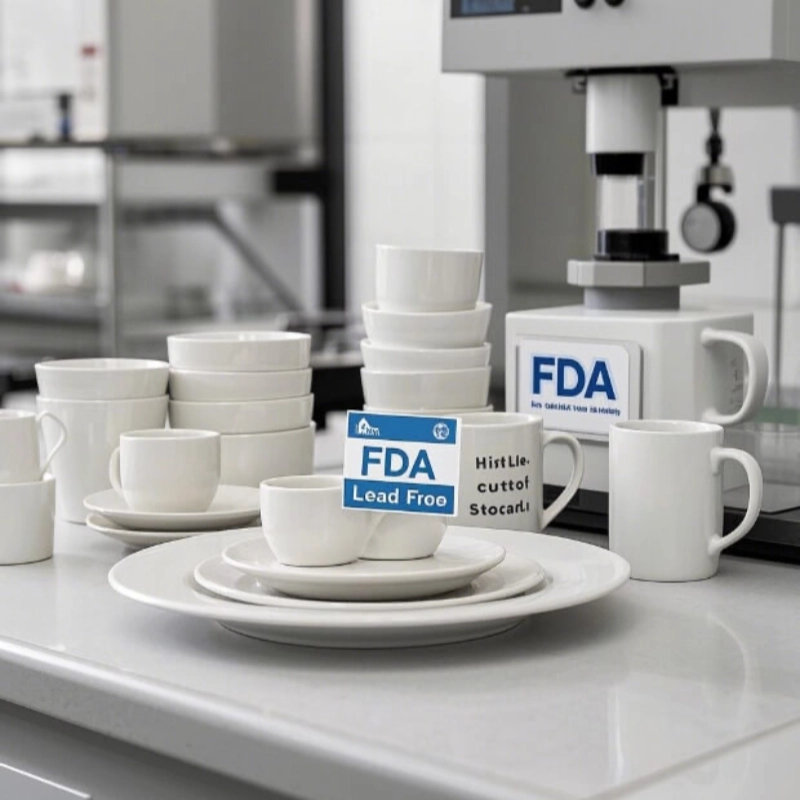
FDA Certified Ceramic Manufacturer: Trusted China Suppliers
March 2, 2026
To the global importers who want to access the US market, it is critical for them to select a genuinely compliant FDA Certified Ceramic Manufacturer. In this article, we will systematically dissect what FDA certification means, what should be tested, what the misunderstandings are, the review process, and core considerations for procurement. We aim to help you reduce the risk of trade and smoothly get your ceramic products into the US market.
In the global ceramic trade, the US remains one of the most important import markets. Whether you’re a tableware brand owner, chain retailer, e-commerce seller, or catering supply chain buyer, when looking for Chinese suppliers, you’ll focus on one key keyword—FDA Certified Ceramic Manufacturer.
However, the problem is that many factories claim to be “FDA compliant,” but few importers truly understand US regulations.
As an industry platform bringing together many high-quality ceramic enterprises in Chaozhou, the Chaozhou Ceramic Manufacturers Association has long connected with the needs of European and American buyers. This article will provide a comprehensive explanation of the key considerations when choosing an FDA Certified Ceramic Manufacturer from a professional, practical, and B2B procurement perspective.
1. Ability to Provide Authoritative Third-Party Testing Reports
For example:
SGS
Intertek
BV
The report must include:
Testing standard number
Product photos
Batch information
Laboratory stamp
2. A Stable Quality Control System
Typically, this is accompanied by certifications such as:
ISO 9001
ISO 14001
ISO 45001
These systems ensure that the factory can consistently control raw materials and glaze formulations during the production process.
3. Familiarity with US Market Regulatory Updates
For example:
California Proposition 65 (CA65)
US State-Level Supplemental Regulations
A mature FDA Certified Ceramic Manufacturer will proactively inform clients of regulatory changes, rather than waiting for clients to discover the problem.
Advantages of Choosing an FDA Certified Ceramic Manufacturer
✅ Pros
Reduced US Customs risks
Enhanced brand compliance image
Easier access to large retail systems (Walmart/Costco)
Improved Amazon selling account security
Reduced product recall risk
❌ Cons
Higher testing costs
Potentially longer sampling time
Some low-priced factories cannot meet standards
However, in the long run, the cost of choosing a reputable FDA Certified Ceramic Manufacturer is far lower than the loss from a single return or recall.
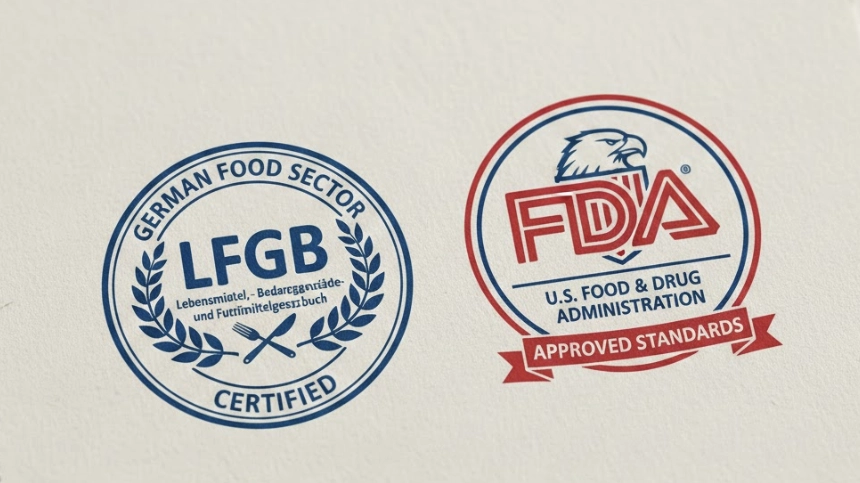
Differences between FDA and LFGB
Many importers ask:
US customers require FDA approval, what do European customers require?
Simple Comparison:
Certification Standard
Target Market
Main Testing Focus
Strictness Level
FDA (U.S. Food and Drug Administration)
United States
Lead & Cadmium Migration Limits
High
LFGB (German Food Contact Regulation)
Germany & EU
Comprehensive Food Contact Safety Testing
Very High
If your products are sold to both Europe and the US, it is recommended to choose a factory that meets both FDA and LFGB standards.
We are not only an information display platform, but also a bridge between global buyers and high-quality manufacturers.
FAQ: Most Frequently Asked Questions by Importers
Q1: Is FDA certification valid indefinitely?
No. FDA testing is based on product batch or model and requires periodic updates.
Q2: Can customs clearance be achieved without FDA certification?
Theoretically, declaration is possible, but failure to pass random inspection will result in the risk of goods being seized.
Q3: Do OEM products need to be retested?
Usually yes. Different glazes or decorations may affect the test results.
Q4: Are FDA and CA65 the same?
No. CA65 is a California regulation, which is usually stricter than the standard FDA.
Q5: How to verify the authenticity of a test report?
You can check the report number on the testing agency’s official website.
Future Trends: Compliance Will Become a Core Competency
Against the backdrop of increasingly stringent global trade regulations:
The US is strengthening regulations on food contact materials
E-commerce platforms are raising compliance thresholds
Large retailers are strengthening supply chain audits
In the future, only FDA Certified Ceramic Manufacturers with true long-term compliance capabilities will be able to secure continuous orders.
Conclusion
For importers looking to deepen their presence in the US market, choosing a reliable FDA Certified Ceramic Manufacturer is not only a regulatory requirement but also an integral part of their brand strategy.
The Chaozhou Ceramic Manufacturers Association brings together numerous high-quality factories that have passed international quality system and food safety testing, dedicated to helping global buyers:
Quickly match compliant suppliers
Reduce import risks
Enhance brand competitiveness
If you are looking for a trustworthy FDA Certified Ceramic Manufacturer, welcome to use our platform to obtain more supplier information and customized solutions.